Support our educational content for free when you buy through links on our site. Learn more
🤖 How Robot Wrestlers Are Designed & Built for Competition (2026)

Ever watched a 250-pound metal beast slam into an opponent, sending sparks flying like a fireworks display, and wondered, “How on earth did they build that?” At Robot Wrestling™, we’ve spent countless hours in the pits, grease under our fingernails, watching teams tear their bots apart and rebuild them in the blink of an eye. The secret isn’t just brute force; it’s a delicate dance of systems engineering, modular design, and real-time AI logic. From the University of Utah’s autonomous challengers to the heavy hitters of the NHRL, the journey from a CAD sketch to a championship trophy is paved with broken gears and burnt circuits.
In this deep dive, we’re pulling back the curtain on the entire lifecycle of a competitive robot wrestler. We’ll explore how engineers select high-torque actuators that can withstand thousands of pounds of force, why sensor fusion is the difference between a blind stumble and a perfect takedown, and how the “20-minute repair rule” can make or break a season. You’ll learn the specific materials that turn a flimsy frame into an indestructible fortress and the algorithms that allow a bot to “think” mid-fight. By the end, you’ll understand exactly what it takes to design a machine that doesn’t just survive the arena, but dominates it.
Key Takeaways
- Modularity is Critical: Successful designs prioritize rapid repair capabilities, allowing teams to swap damaged components in under 20 minutes between bouts.
- Sensor Fusion is Non-Negotiable: Relying on a single sensor type (like IR) is a recipe for failure; top bots combine Lidar, cameras, and ultrasonic sensors to navigate blind spots.
- Material Science Matters: The balance between lightweight agility and impact resistance is achieved through strategic use of 6061-T6 aluminum, titanium, and carbon fiber.
- Testing Beats Theory: As proven by GMU and Utah teams, rigorous stress testing and simulation are more valuable than perfect initial designs.
- AI Drives Strategy: Modern competitors use Monte Carlo simulations and real-time decision algorithms to adapt tactics dynamically during matches.
Table of Contents
- ⚡️ Quick Tips and Facts
- 🤖 From Sci-Fi Dreams to Metal Reality: A Brief History of Robot Wrestling
- 🧠 The Brain of the Beast: Designing the Control Architecture and AI Logic
- 🦾 Engineering the Muscle: Selecting Actuators, Servos, and Hydraulics
- 🛡️ Armor Up: Chassis Materials, Structural Integrity, and Impact Absorption
- 🔋 Powering the Pit: Battery Chemistry, Voltage Regulation, and Thermal Management
- 👁️ Sensing the Opponent: Lidar, Cameras, and Sensor Fusion for Navigation
- 🥊 The Art of the Takedown: Developing Combat Algorithms and Wrestling Tactics
- 🔧 The Build Process: Step-by-Step Assembly, Wiring, and Firmware Flashing
- 🏆 Competition Rules and Safety Standards: What Every Builder Must Know
- 🛠️ Top Tools and Software for Aspiring Robot Wrestlers
- 🚀 Troubleshooting Common Pitfalls: Why Your Bot Might Be a Paperweight
- 🎓 Learning Resources: Communities, Tutorials, and Mentorship Programs
- 🏁 Conclusion: The Future of Mechanical Mayhem
- 🔗 Recommended Links
- ❓ FAQ: Your Burning Questions About Robot Wrestling Design Answered
- 📚 Reference Links
⚡️ Quick Tips and Facts
Before we dive into the grease, gears, and glory of the arena, let’s hit the ground running with some non-negotiable truths every aspiring robot wrestler needs to know. We’ve seen too many teams burn their budget on the wrong servos or forget the “20-minute repair rule” before their first match.
- Modularity is King: You cannot win if you can’t fix your bot between rounds. As noted by teams at George Mason University, the ability to swap out a broken arm or chassis in under 20 minutes is often the difference between a third-place finish and a championship.
- Test, Test, Test: “We broke a lot of components in testing and had to go back to the drawing board,” admits Sean Becker, a lead engineer on a winning team. Never skip the stress testing phase.
- Sensor Blindness: Infrared sensors are great, but they can be blinded by arena lights or TV cameras. Always have a backup navigation strategy, like ultrasonic or lidar.
- Weight Classes Matter: A 12-pound robot has different physics than a 250-pound BattleBot. Design for your specific class rules.
- The “Pit Stop” Mentality: Your pit crew needs to be choreographed like a Formula One team. Every second counts.
For a deeper dive into the ecosystem you’re entering, check out our comprehensive guide: 🤖 Mechanical Mayhem: The Ultimate Guide to 7 Robot Wrestling Leagues (2026).
🤖 From Sci-Fi Dreams to Metal Reality: A Brief History of Robot Wrestling

The idea of robots fighting isn’t new; it’s been a staple of science fiction since the early 20th century. But moving from the pages of a comic book to a circular arena where sparks fly and metal screams? That’s a story of engineering grit.
The Evolution of the Ring
Early competitions were simple: two autonomous bots, a ring, and a push. The University of Utah’s Robot Wrestling at the U event highlights this evolution, shifting from wheled bots to leged locomotion to mimic human wrestling dynamics. The goal? To tip, shove, or secure the center spot within a 75-second window.
“The competition is unbelievably thrilling. The tension in the maintenance and repair bay preparing for the duel is high. Then you put your robot in the arena, and your heart is pumping at 120 beats per minute.” — Brian Romero, GMU Team Member
From LEGO to BattleBots
The roots of modern robot wrestling often trace back to educational kits. The IT Lab in Hong Kong notes that many students start with LEGO or VEX kits, learning the basics of modular construction and sensor integration. These educational roots have blossomed into professional leagues like the Norwalk Havoc Robot Combat League (NHRL) and the televised spectacle of BattleBots.
The transition from a classroom project to a professional competition involves a massive leap in structural integrity and power density. While a school project might use a standard servo, a pro bot needs high-torque hydraulic actuators capable of delivering thousands of pounds of force.
🧠 The Brain of the Beast: Designing the Control Architecture and AI Logic
You can have the strongest steel and the fastest motors, but without a brain, your robot is just a very expensive paperweight. The control architecture is the nervous system of your wrestler.
Autonomous vs. Remote Control
There are two main schools of thought in robot wrestling design:
- Fully Autonomous: The robot must see, decide, and act on its own. This requires complex sensor fusion and real-time decision-making algorithms.
- Teleoperated: A human pilot controls the bot via radio. This allows for human intuition but requires a robust communication link that won’t suffer from interference.
The Logic of Combat
How does a robot decide to attack? At George Mason University, teams used Monte Carlo simulations to play out thousands of virtual bouts. They discovered that the optimal strategy wasn’t always the most aggressive.
- Defensive Posture: Sometimes, the best move is to wait for the opponent to overextend.
- Target Weakness: As Sean Becker noted, “Based on the simulation, we came up with a unique design that attacks the opponent where they are least protected.”
Key Components of the Control System
| Component | Function | Recommended Tech |
|---|---|---|
| Microcontroller | The central processor for logic | Raspberry Pi 4, NVIDIA Jetson Nano |
| Sensor Hub | Merging data from cameras, lidar, IR | Arduino Mega, STM32 |
| Power Distribution | Managing high-current spikes | BEC (Battery Eliminator Circuit) |
| Communication | Remote control or telemetry | 2.4GHz RC Transmitters, Wi-Fi 6 |
Pro Tip: If you are building an autonomous bot, don’t rely solely on infrared sensors. As seen in the University of Utah competition, TV cameras can blind IR sensors. Implement ultrasonic or lidar as a fail-safe.
🦾 Engineering the Muscle: Selecting Actuators, Servos, and Hydraulics
This is where the magic happens. The actuators are the muscles that determine if your robot can lift, push, or spin. Choosing the wrong one is a recipe for disaster.
Servos vs. Hydraulics vs. Electric Motors
- Standard Servos: Great for small, lightweight bots (under 5 lbs). Brands like Futaba and Hitec offer reliable options, but they can strip gears under high load.
- High-Torque Digital Servos: Essential for the 12-25 lb class. Look for metal gears and brushless motors.
- Hydraulics: The heavy hitters. Used in 250+ lb bots, hydraulics provide immense force but add weight and complexity.
- Brushless DC Motors: The standard for wheel drive. They offer high efficiency and speed.
The “Life-Cycle” of a Component
One of the biggest mistakes teams make is ignoring the life-cycle analysis. A component might work perfectly in the first bout but fail in the second due to heat or fatigue.
- Thermal Management: Motors get hot. Use heat sinks and thermal paste.
- Gearbox Integrity: Plastic gears melt; metal gears strip. Carbon fiber or aluminum gearboxes are the gold standard for competitive bots.
“We broke a lot of components in testing and had to go back to the drawing board to redesign over and over again.” — Sean Becker
Recommended Actuators for Different Classes
- Lightweight (1-5 lbs): Dynamixel MX-28 (High precision, daisy-chainable)
- Mid-Weight (12-25 lbs): KST 250 (High torque, metal gears)
- Heavyweight (250+ lbs): Custom Hydraulic Cylinders or Maxon EC-i motors with planetary gearboxes.
👉 Shop High-Torque Servos on:
- Amazon: Search for High Torque Metal Gear Servos
- Brand Official: Dynamixel Official Store | KST Servo Official
🛡️ Armor Up: Chassis Materials, Structural Integrity, and Impact Absorption
Your robot’s chassis is its skeleton and skin. It must be lightweight enough to be agile but strong enough to survive a 50-joule impact.
Material Selection
- Aluminum (6061-T6): The industry standard. Easy to machine, good strength-to-weight ratio.
- Titanium: Expensive but incredibly strong and light. Used in top-tier BattleBots.
- Carbon Fiber: Excellent for non-structural panels and armor plating.
- Steel (Chromoly): Heavy but virtually indestructible. Often used for the “spine” of the robot.
Structural Design Principles
- Triangulation: Use triangular bracing to distribute impact forces.
- Modularity: As highlighted in the GMU study, design your bot so that if the front armor is destroyed, you can swap it out in minutes.
- Low Center of Gravity: A high bot tips over easily. Keep the batteries and heavy components low.
Impact Absorption
Don’t just rely on hard armor. Use shock absorbers or ruber dampeners to protect your electronics from the shock of a collision. A cracked circuit board is a silent killer.
🔋 Powering the Pit: Battery Chemistry, Voltage Regulation, and Thermal Management
Power is life. But in robot wrestling, power is also a fire hazard.
Battery Chemistry
- LiPo (Lithium Polymer): The most common choice. High discharge rates (C-rating) are crucial for sudden bursts of speed.
- Li-ion: Higher energy density, but lower discharge rates. Good for endurance, bad for combat.
- LiFePO4: Safer, but heavier and lower voltage.
Voltage Regulation
Your motors might need 24V, but your brain (Raspberry Pi) needs 5V. A BEC (Battery Eliminator Circuit) or a dedicated DC-DC converter is essential to step down voltage without frying your logic board.
Thermal Management
High currents generate heat.
- Wire Gauge: Use the correct AWG wire. Too thin, and you’ll have voltage drops or melted insulation.
- Connectors: AS150 or Deans connectors are standard for high-current applications. Avoid cheap XT60s for 250lb bots.
👁️ Sensing the Opponent: Lidar, Cameras, and Sensor Fusion for Navigation
How does your robot know where the opponent is? Sensor fusion is the answer.
Sensor Types
- Lidar: Provides a 360-degree map of the arena. Excellent for autonomous navigation.
- Cameras: Essential for visual recognition (e.g., identifying the opponent’s color or shape).
- Ultrasonic: Good for short-range distance measurement, but can be fooled by soft surfaces.
- Infrared (IR): Fast and cheap, but susceptible to light interference.
The “Blind Spot” Problem
In the University of Utah competition, teams had to redesign their IR sensors to avoid interference from TV cameras. This is a common issue. Solution: Use multi-sensor arrays. If the IR fails, the lidar takes over.
🥊 The Art of the Takedown: Developing Combat Algorithms and Wrestling Tactics
Designing the bot is only half the battle. You need a fighting strategy.
Offensive vs. Defensive Algorithms
- Agressive: Constantly move toward the opponent, aiming to push them out of the ring.
- Defensive: Wait for the opponent to make a mistake, then counter-attack.
- Hybrid: Use Monte Carlo simulations to predict the opponent’s move and adapt in real-time.
Tactics from the Pros
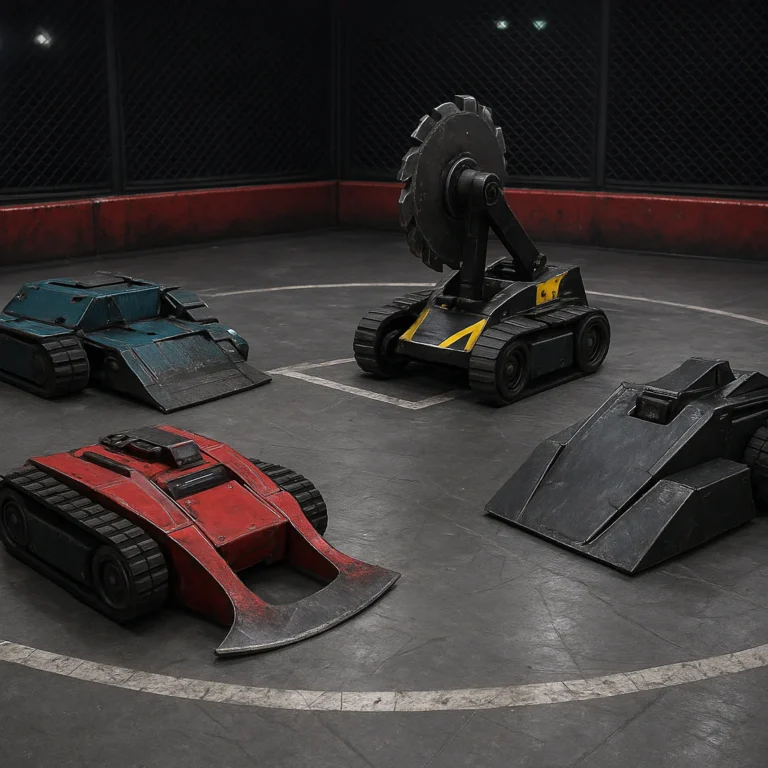
- The Wedge: A low-profile design that slides under the opponent to lift them.
- The Spinner: Uses kinetic energy to deliver massive impact.
- The Grapler: Uses arms to grab and throw.
“As systems engineers, and by applying the systems engineering methods, we had a big advantage over the competition.” — Sean Becker
🔧 The Build Process: Step-by-Step Assembly, Wiring, and Firmware Flashing
Ready to build? Here is the roadmap to victory.
- CAD Design: Use Fusion 360 or SolidWorks to model every part. Run Finite Element Analysis (FEA) to simulate stress.
- Fabrication: Cut, machine, and 3D print your parts.
- Assembly: Start with the chassis, then mount motors, then electronics.
- Wiring: Keep power and signal wires separate to avoid noise. Use heat shrink and zip ties.
- Firmware: Flash your code. Test basic movements first, then add combat logic.
- Testing: Break it. Fix it. Repeat.
🏆 Competition Rules and Safety Standards: What Every Builder Must Know
Before you step into the ring, know the rules.
- Weight Limits: Strictly enforced.
- Weapon Restrictions: Some leagues ban spinning weapons or limit energy output.
- Safety: All bots must have a kill switch and a remote kill switch.
- Repair Time: Usually 20 minutes between bouts.
Check the specific rules of your league, whether it’s the NHRL or the IT Lab challenge.
🛠️ Top Tools and Software for Aspiring Robot Wrestlers
You can’t build a robot with a hammer and a prayer. You need the right tools.
Essential Hardware
- 3D Printer: For protyping parts.
- CNC Machine: For metal chassis.
- Soldering Station: For electronics.
- Multimeter: For troubleshooting.
Essential Software
- CAD: Fusion 360, SolidWorks.
- Simulation: Gazebo, MATLAB.
- Programming: Python, C++, ROS (Robot Operating System).
👉 Shop Robotics Tools on:
- Amazon: Search for Robotics Tool Kits
- Brand Official: Fusion 360 | Arduino Official
🚀 Troubleshooting Common Pitfalls: Why Your Bot Might Be a Paperweight
Even the best designs fail. Here’s why:
- Lose Connections: The #1 cause of failure. Check every solder joint.
- Overheating: Motors and batteries get hot. Add cooling.
- Software Bugs: Test your code in simulation first.
- Weight Issues: Add too much armor, and you lose speed.
“I never really appreciated the importance of testing, testing, testing.” — Brian Romero
🎓 Learning Resources: Communities, Tutorials, and Mentorship Programs
You don’t have to do it alone.
- Communities: Join forums like The Robot Room or Discord groups for robot builders.
- Tutorials: Check out Instructables and Hackster.io for step-by-step guides.
- Mentorship: Reach out to university teams or local makerspaces.
🏁 Conclusion: The Future of Mechanical Mayhem

So, is building a robot wrestler worth the sleepless nights, the burnt fingers, and the shattered gears? Absolutely.
We started this journey asking how robots are designed to survive the chaos of the arena. We’ve explored the modular chassis that allows for rapid repairs, the sensor fusion that keeps them from going blind, and the algorithms that turn cold code into a fighting spirit. The secret, as the teams at George Mason University and the University of Utah have shown, isn’t just about having the strongest motor or the sharpest wedge. It’s about systems engineering. It’s about designing for the entire life-cycle of the competition, from the first simulation to the final pit stop.
The future of robot wrestling is bright. With advancements in AI, lighter materials, and more powerful batteries, we are moving closer to the day when robots can not only fight but also strategize with the cunning of a grandmaster. Whether you are a student building your first LEGO bot or a pro engineer designing a 250-pound beast, the arena awaits.
Will your bot be the one to stand tall when the dust settles?
🔗 Recommended Links
Ready to start building? Here are the essential tools and components we recommend based on our experience in the pits.
👉 Shop High-Torque Servos and Motors:
- Dynamixel Servos: Amazon Search | Official Store
- KST High Torque Servos: Amazon Search | Official Store
👉 Shop Chassis Materials and Tools:
- Aluminum Sheets (6061-T6): Amazon Search
- Fusion 360 (CAD Software): Autodesk Official
- 3D Printers for Protyping: Amazon Search
Books and Guides:
- “Make: Robotics” by Simon Monk: Amazon Link
- “Robotics: A Very Short Introduction” by Alan Winfield: Amazon Link
❓ FAQ: Your Burning Questions About Robot Wrestling Design Answered

What materials are best for building durable robot wrestling frames?
The best materials balance strength-to-weight ratio. 6061-T6 Aluminum is the industry standard for frames due to its machinability and strength. For high-impact areas, Chromoly Steel or Titanium is preferred, though it adds weight. Carbon Fiber is excellent for armor plating but can be brittle under direct impact.
Read more about “What Materials Are Best for Building a Robot Wrestling Frame? 🛠️ (2026)”
How do robot wrestlers survive high-impact collisions during matches?
Survival comes down to structural design and energy absorption.
- Triangulation: Distributes force across the frame.
- Low Center of Gravity: Prevents tipping.
- Shock Absorption: Using rubber dampeners or flexible mounts to protect sensitive electronics.
- Modularity: If a part breaks, it’s designed to be easily swapped out.
Read more about “Top 15 Most Popular Robot Wrestling Designs and Why They Dominate (2026) 🤖”
What safety regulations must robot designs meet for official league competition?
Every league has specific rules, but common requirements include:
- Kill Switch: A physical switch to cut power immediately.
- Remote Kill Switch: A radio-controlled safety cut-off.
- Weight Limits: Strict adherence to class weights.
- Weapon Restrictions: Limits on energy output (joules) and weapon types (e.g., no open flames or explosives).
Read more about “🤖 DIY Fighting Robots: The Ultimate 2026 Build Guide (12 Steps)”
How are the weapons and grippers on combat robots engineered for maximum damage?
Weapons are designed to maximize kinetic energy ($KE = 1/2 mv^2$).
- Spiners: Use heavy flywheels spinning at high RPMs.
- Wedges: Use a low angle to lift and destabilize the opponent.
- Grippers: Use high-torque servos or hydraulics to apply crushing force.
- Materials: Weapons are often made of tool steel or titanium to withstand repeated impacts.
What programming logic controls a robot’s movement and attack strategies?
Logic ranges from simple state machines (e.g., “if obstacle, turn”) to complex AI algorithms using Monte Carlo simulations or reinforcement learning.
- Sensor Fusion: Combining data from lidar, cameras, and ultrasonic sensors to build a map.
- Path Planning: Calculating the optimal route to the opponent.
- Decision Making: Choosing between attack, defend, or retreat based on real-time data.
Read more about “🤖 AI Combat Robots: The 2026 Future of Autonomous Warfare”
How much does it cost to design and build a competitive robot wrestler?
Costs vary wildly.
- Entry Level (LEGO/VEX): $20 – $1,0.
- Mid-Weight (12-25 lbs): $2,0 – $10,0.
- Heavyweight (250 lbs): $20,0 – $10,0+.
- Hidden Costs: Don’t forget the cost of tools, protyping materials, travel, and entry fees.
What are the most common design failures seen in robot wrestling tournaments?
- Lose Connections: Vibrations shake wires loose.
- Overheating: Motors and batteries failing due to lack of cooling.
- Weight Issues: Adding too much armor, making the bot slow.
- Sensor Failure: IR sensors blinded by arena lights.
- Poor Modularity: Inability to repair the bot between rounds.
Read more about “🤖 15 Essential Robot Building Tutorials for 2026: From Gears to AI”
📚 Reference Links
- George Mason University: When Robots Meet Sumo Wrestling
- University of Utah: Robot Wrestling at the U
- IT Lab (Hong Kong): Robotic Challenge – Robot Wrestling
- Robot Wrestling™: Mechanical Mayhem: The Ultimate Guide to 7 Robot Wrestling Leagues (2026)
- Robot Wrestling™: Competitions
- Robot Wrestling™: History of Robot Wrestling
- Autodesk: Fusion 360
- Arduino: Official Store
- Dynamixel: Official Store
- KST Servo: Official Store