Support our educational content for free when you buy through links on our site. Learn more
Can I Build My Own Robot Wrestler? The Ultimate 2026 Guide 🤖

Yes, you absolutely can build your own robot wrestler for competition or hobby, and you don’t need a million-dollar budget to start. Whether you are asking “Can I build my own robot wrestler for competition or hobby?” because you dream of the arena or just want a weekend project, the answer is a resounding yes.
The barrier to entry has never been lower. Just last year, a high school student built a championship-winning Antweight bot in his garage for under $20 using 3D-printed parts and off-the-shelf motors. It turns out, the difference between a scrap heap and a champion often comes down to design philosophy and safety, not just raw cash.
Imagine the thrill of watching your creation flip a 150-pound opponent across the arena. That moment of pure adrenaline is why thousands of hobbyists are diving into DIY robot wrestling every year. But before you start cutting metal, you need to know the rules, the risks, and the right materials.
Key Takeaways
- ✅ Feasibility: You can build a competitive robot wrestler starting with as little as $150 for an Antweight class bot.
- ⚠️ Safety First: A functional remote kill switch and LiPo safety protocols are non-negotiable for any competition entry.
- 🛠️ Materials Matter: Success often hinges on using the right materials like UHMW-PE for armor and Grade 5 Titanium for weapon shafts.
- 🏆 Competition Path: Start with local open qualifiers or “Destruct-A-Thon” events before aiming for major leagues like BattleBots.
- 🔄 Iteration is Key: Expect your first build to fail; the best builders treat every broken part as a lesson learned.
Table of Contents
- ⚡️ Quick Tips and Facts
- 🤖 From Sci-Fi Dreams to Real-World Arenas: The History of DIY Robot Wrestling
- The Early Days: Sumo and the First Sparks
- The BattleBots Revolution
- 🏆 Can You Actually Build and Enter Your Own Robot? The Legal and Competitive Landscape
- The “Open” vs. “Invite-Only” Reality
- Safety and Liability: The Boring but Vital Stuff
- 🛠️ The Ultimate DIY Robot Wrestling Build Guide: From Concept to Combat
- Choosing Your Weapon: Selecting the Right Chassis and Weight Class
- Powering Up: Batteries, Motors, and Speed Controllers Explained
- The Heart of the Beast: Programming and Control Systems
- Armament and Armor: Designing Effective Weapons and Defense
- Assembly and Testing: Putting the Metal to the Mat
- 📜 Navigating the Rules: Understanding Competition Regulations and Safety Standards
- The Universal Safety Rules
- Weapon Restrictions
- 🥊 Finding Your Fight: Where to Enter Your Homemade Robot in Tournaments
- Local and Regional Events
- The Big Leagues
- 💡 Pro Secrets: Lessons Learned from Veteran Robot Wrestlers and Engineers
- 🔧 Troubleshooting Common Pitfalls: Why Your Bot Might Not Fight (or Fly)
- The Bot Won’t Move
- The Weapon Spins but the Bot Doesn’t Drive
- The Bot Flips Over
- 📊 Cost Breakdown: Budgeting for Your First Battle Bot
- 🛡️ Materials Matter: Best Metals and Composites for a Durable Chassis
- 🔌 Power Management: Avoiding Voltage Spikes and Battery Fires
- 🎯 Design Philosophy: Offense vs. Defense in Robot Wrestling
- 🏁 Conclusion
- 🔗 Recommended Links
- ❓ FAQ
- 📚 Reference Links
- Leave a ReplyCancel Reply
- Key Takeaways
- Meta
- Trending now
- Useful Links
⚡️ Quick Tips and Facts
Before you start cutting metal or soldering wires, let’s hit the pause button and get the hard truths out of the way. Building a robot wrestler isn’t just about gluing motors to a chassis; it’s a high-stakes game of physics, engineering, and sheer grit.
- ✅ The “Simplicity Wins” Rule: The most reliable bots are often the simplest. A complex spinner that breaks in the first 10 seconds is worse than a slow, indestructible wedge.
- ✅ Safety is Non-Negotiable: You must have a functional remote kill switch. If your bot goes rogue, you need to cut power instantly. No exceptions.
- ✅ Weight is Your Enemy: Every gram you spend on “cool” aesthetics is a gram stolen from armor or battery life. Weight management is the difference between a champion and a paperweight.
- ✅ The “Buy Two” Rule: If a part can break, it will break. Always budget for a spare chassis, spare motors, and extra fasteners.
- ✅ LiPo Safety: 90% of garage fires in this hobby start with Lithium Polymer (LiPo) batteries. Always charge in a fireproof bag and inspect for swelling.
Curious about how a 1lb bot like “Tytotu” went from a sketch to a Sun City champion? We’ll break down the specific design choices and material failures (yes, even PLA has its limits!) later in this guide.
🤖 From Sci-Fi Dreams to Real-World Arenas: The History of DIY Robot Wrestling

The idea of fighting robots isn’t new; it’s been a staple of science fiction since the 1930s. But turning those dreams into a DIY robot wrestling reality is a story of grit, grease, and a few spectacular explosions.
The Early Days: Sumo and the First Sparks
It all started with Sumo wrestling. In the 1980s and 90s, hobbyists in Japan and the US began building small, autonomous robots to push each other out of a ring. These were the ancestors of modern combat bots. They were slow, often brick-shaped, and relied on simple line-following sensors.
- Key Insight: Early bots were autonomous. The “wrestling” was purely algorithmic.
- The Shift: As remote control technology improved, the focus shifted from “who can program the best AI” to “who can build the toughest machine.” This birthed the remote-controlled combat robot era.
The BattleBots Revolution
The real explosion happened with the TV show BattleBots. Suddenly, garage tinkers were on national television. The show popularized the concept of weaponized robots and established the weight classes we use today.
- The Impact: It turned a niche hobby into a global phenomenon.
- The Evolution: Early seasons featured bots with hammers and saws. Modern seasons feature titanium drum spiners and hydraulic flippers that can launch opponents into the stratosphere.
- Community Growth: This era saw the rise of forums like the BattleBots Community and the Robot Combat League, where builders could share schematics and learn from failures.
Did you know? Legendary bots like Copperhead were built in suburban garages with budgets smaller than a used car. You don’t need a corporate team to win; you just need a good idea and a lot of patience.
🏆 Can You Actually Build and Enter Your Own Robot? The Legal and Competitive Landscape
So, you’ve built a beast. Now, can you actually get it into the ring? The answer is a resounding yes, but the path isn’t always a straight line.
The “Open” vs. “Invite-Only” Reality
Not all tournaments are created equal.
- Open Qualifiers: Events like the Robot Fighting League (RFL) and local maker faires often have open registration. If you pass safety inspection, you’re in.
- Invite-Only: Major events like the BattleBots World Championship often require an invitation based on past performance or a rigorous application process.
- The “Destruct-A-Thon”: This is the perfect entry point for rookies. It explicitly invites new teams to test their bots in a controlled environment.
Safety and Liability: The Boring but Vital Stuff
This is the part most builders skip until it’s too late.
- Liability Waivers: You must sign a waiver. If your bot destroys the arena or injures someone, you are personally liable.
- Insurance: Many events require proof of liability insurance. Check with your homeowner’s policy; experimental combat robots are often excluded.
- Technical Inspection: Every bot must pass a rigorous check.
Secure Battery Mounting: No loose LiPos!
Kill Switch Verification: The inspector will test your remote kill switch. If it fails, you don’t fight.
Weight Compliance: Being even 0.1 ounces over can lead to disqualification.
Pro Tip: Before you even think about registering, read the official rules. For a deep dive, check out our guide on 🤖 Robot Wrestling Rules: The Ultimate 2026 Guide to Leagues & Regulations.
🛠️ The Ultimate DIY Robot Wrestling Build Guide: From Concept to Combat
Ready to build? Let’s get our hands dirty. This is the step-by-step process to turning a sketch into a combat-ready machine.
Choosing Your Weapon: Selecting the Right Chassis and Weight Class
Your first decision defines your entire build.
- Antweight (1 lb / 454g): Perfect for beginners. Low cost, easy to machine, and great for learning the basics.
- Betleweight (3 lbs / 1.36kg): The “Goldilocks” zone. Heavy enough for real impact, light enough to build without a full machine shop.
- Featherweight (30 lbs): High difficulty. Requires custom machining and significant budgets.
- Heavyweight (250 lbs): The big leagues. Extreme difficulty, massive budgets, and often requires a team.
Design Philosophy:
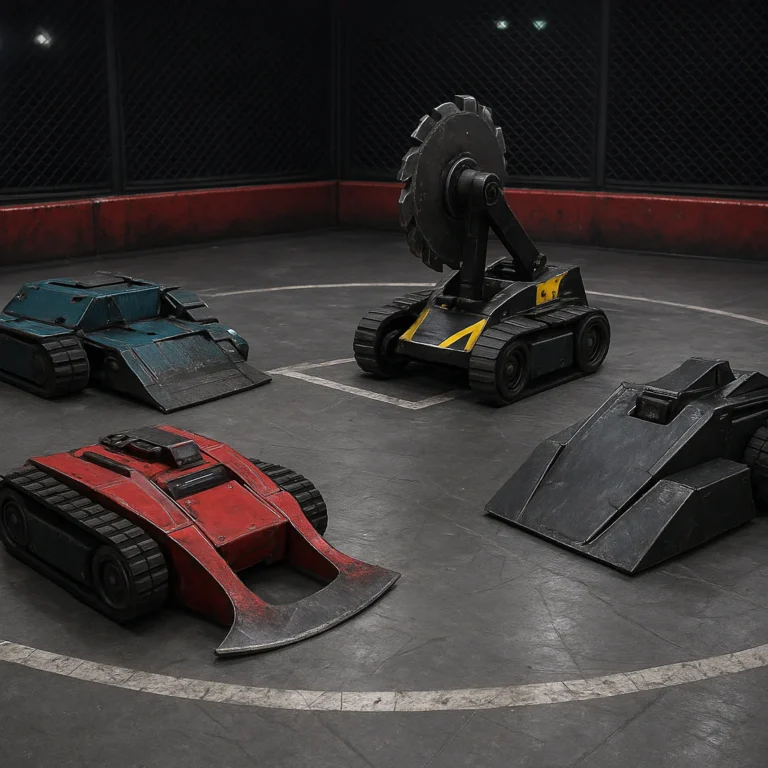
- Wedge: Simple, effective, hard to break. Good for beginners.
- Spinner (Vertical/Horizontal): High damage, high risk. If the weapon breaks, the bot is useless.
- Fliper: High skill ceiling. Requires precise timing and powerful hydraulics.
Powering Up: Batteries, Motors, and Speed Controllers Explained
The heart of your bot.
- Batteries: LiPo (Lithium Polymer) is the standard. Look for high C-ratings (discharge rates).
Warning: Never use a swollen LiPo. It’s a fire hazard. - Motors:
Brushed: Good for low-weight classes (Ant/Betle).
Brushless (BLDC): The gold standard for weapon power and efficiency.
Brands: Maxon, BaneBots, Scorpion. - Speed Controllers (ESCs): Must be rated for the motor’s continuous amperage.
Recommendation: Castle Creations Mamba series. Avoid cheap drivers like the L298N for weapons; they are a primary cause of “smoke-machine moments.”
👉 Shop Motors and ESCs on:
- BaneBots: Amazon Search | BaneBots Official
- Castle Creations: Amazon Search | Castle Creations Official
The Heart of the Beast: Programming and Control Systems
- Remote Control (RC): You need a low-latency transmitter. Futaba and Spektrum are industry standards.
- Autonomous: If you’re building an autonomous bot, you’ll need a microcontroller like Arduino or Raspberry Pi.
Coding: C++ or Python.
Sensors: GY-521 MPU6050 for stability, VL53L0X for obstacle avoidance.
Armament and Armor: Designing Effective Weapons and Defense
- Materials:
UHMW-PE: The “slipery superhero” for wedges. Absorbs impact and is self-lubricating.
7075 Aluminum: Great for internal frames.
Titanium (Grade 5): The “holy grail” for weapon shafts and top armor. Strong but expensive.
Spring Steel (AR40/AR50): Essential for drum and disk weapons. - Fasteners: Use Grade 8 Bolts and Loctite 242 (Blue) on every bolt. Vibration will loosen everything else.
Assembly and Testing: Putting the Metal to the Mat
Don’t just build it; test it.
- Dry Run: Test electronics without weapons.
- Static Test: Spin the weapon while clamped to a test stand.
- Dynamic Test: Verify steering isn’t affected by weapon operation.
- Safety Check: Verify the kill switch every single time.
Remember the “Tytotu” video? The creator mentioned that using PLA filament for some parts resulted in them bending and breaking. They switched to Nylon or PETG for durability. Always test your materials!
📜 Navigating the Rules: Understanding Competition Regulations and Safety Standards
Every league has its own rulebook, but there are universal truths.
The Universal Safety Rules
- Remote Kill Switch: Mandatory. Must be a “dead-man” switch.
- Eye Protection: ANSI Z87+ safety glasses are required for everyone in the arena.
- Fire Safety: Fire extinguishers must be present. LiPo bags are a must for charging.
Weapon Restrictions
- No Pyrotechnics: No explosives, no flames (unless it’s a specific flame-thrower class, which is rare).
- No Fluids: No oil, water, or other liquids that could damage the arena or other bots.
- Sharp Edges: All edges must be deburred. No “razor wire” allowed.
🥊 Finding Your Fight: Where to Enter Your Homemade Robot in Tournaments
Where do you take your creation?
Local and Regional Events
Start small. Look for local maker faires, robotics clubs, or regional leagues.
- Benefits: Lower stakes, great for learning, and you can meet other builders.
- Examples: BattleBots: Destruct-A-Thon, RFL regional qualifiers.
The Big Leagues
Once you’ve got some wins under your belt, aim for the big time.
- BattleBots: The pinnacle of the sport. Requires an invitation or a top finish in qualifiers.
- Robot Fighting League (RFL): A global league with regular events.
- World Robot Boxing: Another major international competition.
Want to see the action? Check out our Famous Matches section for highlights from the most epic battles in history.
💡 Pro Secrets: Lessons Learned from Veteran Robot Wrestlers and Engineers
We’ve talked to the best, and here’s what they told us:
- “If your bot isn’t broken, you aren’t trying hard enough.” Iteration is key.
- “The difference between victory and defeat often comes down to a $5 wire that vibrated loose.” Secure your wiring!
- “Weight is your enemy.” Every gram counts.
- “Design is an iterative process. You will never get it right the first time.” Embrace failure.
🔧 Troubleshooting Common Pitfalls: Why Your Bot Might Not Fight (or Fly)
Even the best builders hit snags. Here’s how to fix them.
The Bot Won’t Move
- Check the Battery: Is it fully charged? Is the connector secure?
- Check the ESC: Is the motor plugged into the correct channel?
- Check the Radio: Is the transmitter on? Is the receiver paired?
The Weapon Spins but the Bot Doesn’t Drive
- Power Drain: Your weapon might be drawing all the power, leaving none for the drive motors. Check your voltage regulator or use a separate battery for the weapon.
- ESC Configuration: Ensure your drive ESCs aren’t in “brake” mode.
The Bot Flips Over
- Center of Gravity (CoG): Is your battery too high? Mount it flat on the floor.
- Wedge Angle: Is your wedge too steep? It should be ≤ 30° to slip under opponents.
- Weight Distribution: Is your weapon too heavy one side? Balance the bot.
📊 Cost Breakdown: Budgeting for Your First Battle Bot
Building a robot can be as cheap or as expensive as you want. Here’s a rough estimate (excluding tools).
| Weight Class | Estimated Cost | Difficulty | Key Components |
|---|---|---|---|
| Antweight (1 lb) | $150 – $30 | Low | Brushed motors, simple electronics, 3D printed parts |
| Betleweight (3 lb) | $50 – $1,50 | Medium | Brushless motors, LiPo, aluminum/titanium armor |
| Featherweight (30 lb) | $2,0 – $15,0+ | High | Custom machining, high-end electronics, titanium |
| Heavyweight (250 lb) | $50,0+ | Extreme | Team effort, CNC, professional engineering |
Note: These are estimates. A simple wedge bot can be built for less, while a complex spinner can cost a fortune.
🛡️ Materials Matter: Best Metals and Composites for a Durable Chassis
Choosing the right material is critical.
| Material | Strength | Weight | Cost | Best Use |
|---|---|---|---|---|
| UHMW-PE | High Impact | Light | Low | Wedges, bumpers, armor |
| 6061-T6 Aluminum | Medium | Medium | Low | Internal frames, motor mounts |
| Titanium (Grade 5) | Very High | Medium | High | Weapon shafts, top armor |
| Spring Steel (AR40) | Very High | Heavy | Medium | Drum/disk weapons |
| Carbon Fiber | High | Very Light | High | Top covers (britle under impact) |
| PLA+ / PETG | Low/Med | Light | Low | Protyping, non-critical parts |
👉 Shop Materials on:
- McMaster-Carr: Fasteners & Materials
- SendCutSend: Custom Metal Parts
- Amazon: UHMW Sheets | Titanium Rods
🔌 Power Management: Avoiding Voltage Spikes and Battery Fires
Power is dangerous. Treat it with respect.
- Battery Management Systems (BMS): Essential for LiPo safety.
- Fireproof Containment: Always charge and store LiPos in a fireproof bag.
- Connectors: Use XT60, XT90, or EC5 connectors. Avoid weak crimps; solder your connections.
- Strain Relief: Secure wires to prevent pull-out during combat.
🎯 Design Philosophy: Offense vs. Defense in Robot Wrestling
What’s your strategy?
- Offense: High-damage weapons (spiners, flippers). Risk: High chance of self-destruction.
- Defense: Armor, wedges, low center of gravity. Risk: Can be outmaneuvered.
- Hybrid: A balanced approach. Good armor with a moderate weapon.
Final Thought: “If you can wield a screwdriver and follow a wiring diagram, you’re 80% of the way there.” The other 20% is learning how to fix the smoke.
🏁 Conclusion

So, can you build your own robot wrestler? Absolutely. Whether you’re a seasoned engineer or a curious beginner, the world of DIY robot wrestling is open to you. It’s a journey of trial, error, and eventual triumph. You’ll learn about physics, electronics, and materials science, all while building a machine that can fight.
Remember the key takeaways:
- Start small. Antweight or Beetleweight is the perfect place to begin.
- Prioritize safety. A kill switch is non-negotiable.
- Embrace failure. Your first bot will break. Your second will better.
- Join the community. Learn from others, share your knowledge, and have fun.
The next champion could be built in your garage. Will it be yours?
🔗 Recommended Links
Ready to get started? Here are some essential resources and products to kickstart your build.
👉 Shop Essential Components on:
- Motors & ESCs:
BaneBots: Amazon Search | BaneBots Official
Castle Creations: Amazon Search | Castle Creations Official - Materials:
McMaster-Carr: Fasteners & Materials
SendCutSend: Custom Metal Parts
Amazon: UHMW Sheets | Titanium Rods - Books:
“Build Your Own Combat Robot” by Peter Alan: Amazon Link
“Robot Combat League: The Official Guide” by RFL: Amazon Link
❓ FAQ

How do I program a robot wrestler for battle strategies?
Programming a robot wrestler depends on whether it’s remote-controlled or autonomous. For remote-controlled bots, you use a standard RC transmitter (like Futaba or Spektrum) to control the motors and weapons. For autonomous bots, you’ll need a microcontroller like Arduino or Raspberry Pi and code in C++ or Python. You can use sensors like GY-521 MPU6050 for stability and VL53L0X for obstacle avoidance.
Read more about “🤖 7 Top Robot Wrestling Designs & Why They Dominate (2026)”
What are the most common types of robot wrestlers in competitions?
The most common types are:
- Wedges: Simple, effective, and hard to break.
- Spiners (Vertical/Horizontal): High damage, high risk.
- Flippers: High skill ceiling, require precise timing.
- Hammers/Spikes: Less common, but can be devastating.
Read more about “🤖 7 Types of Robots Used in Pro Wrestling (2026)”
Can I use 3D printing to create parts for my robot wrestler?
Yes, but choose your material wisely. PLA is too brittle for combat. Use PETG, Nylon, or TPU for impact absorption. For critical structural parts, metal (aluminum, titanium) is still king.
Are there specific rules for robot design in robot wrestling competitions?
Yes. Every league has its own rulebook, but common rules include:
- Weight Limits: Strict tolerances (e.g., 0.1 oz).
- Safety: Mandatory kill switch, no pyrotechnics, no fluids.
- Weapon Restrictions: No sharp edges, no unauthorized weapons.
Read more about “🤖 Robot Wrestling Rules: The Ultimate 2026 Guide to Leagues & Regulations”
What skills do I need to build a robot for the Robot Wrestling League?
You need basic skills in:
- Mechanical Design: CAD software (Fusion 360, SolidWorks).
- Electronics: Soldering, wiring, understanding ESCs and motors.
- Programming: Basic coding for autonomous bots.
- Problem Solving: The ability to troubleshoot and iterate.
Read more about “🤖 Robo Wars Tournament: The Ultimate 2026 Guide to Combat Robotics”
What materials are best for building a robot wrestler?
- UHMW-PE: For wedges and armor.
- 6061-T6 Aluminum: For frames.
- Titanium (Grade 5): For weapon shafts and top armor.
- Spring Steel (AR40): For drum/disk weapons.
Read more about “💸 Robot Wrestling Cost: The Real Price to Build a Champion (2026)”
Where can I find parts and kits for building robot wrestlers?
- Online Retailers: McMaster-Carr, SendCutSend, Amazon, BaneBots, Castle Creations.
- Local: Scrap yards, machine shops.
- Communities: Reddit r/BattleBots, Robot Combat Forum.
Read more about “How Much Does It Cost to Build a Competitive Robot Wrestler? 🤖 (2026)”
How do I program a robot for wrestling matches?
For remote-controlled bots, you don’t need to program; you just use an RC transmitter. For autonomous bots, you’ll need to code using a microcontroller (Arduino, Raspberry Pi) and sensors. You can start with simple line-following algorithms and progress to object detection and targeting.
What are the best designs for robot wrestlers?
There’s no single “best” design. It depends on your skills and budget.
- Beginers: Wedges (simple, effective).
- Intermediate: Spiners (high damage, but risky).
- Advanced: Flippers or hybrid designs.
Read more about “🤜🤛 Humanoid Robot Wrestling: The 2026 Guide to the Future of Combat”
Can beginners participate in the Robot Wrestling League?
Yes! Many leagues have open qualifiers and beginner-friendly events. Start with Antweight or Betleweight classes.
Read more about “🤖 15 Ultimate Robot Battle Arena Games & Kits to Dominate (2026)”
Are there specific rules for robot wrestling competitions?
Yes. Common rules include weight limits, safety requirements (kill switch), and weapon restrictions. Always check the specific rulebook of the league you’re entering.
Read more about “🤖 Yes! How to Build & Enter Your Own Robot Wrestler (2026)”
What materials do I need to build a robot wrestler?
- Chassis: Aluminum, titanium, UHMW-PE.
- Motors: Brushless or brushed, depending on weight class.
- Electronics: ESCs, batteries (LiPo), RC transmitter/receiver.
- Fasteners: Grade 8 bolts, Loctite.
- Tools: Soldering iron, drill, saw, CAD software.
Read more about “🤖 How Robot Wrestlers Are Designed & Built for Competition (2026)”
📚 Reference Links
- Robot Wrestling™: Can Anyone Build a Robot for Wrestling? 7 Must-Have Materials (2026)
- BattleBots: Official Website
- Robot Fighting League (RFL): Official Website
- McMaster-Carr: Fasteners & Materials
- SendCutSend: Custom Metal Parts
- BaneBots: Motors & Gearboxes
- Castle Creations: ESCs & Batteries
Leave a ReplyCancel Reply
Name *
Email *
Website
[Post Comment]
Key Takeaways
- Yes, you can build your own robot wrestler. It’s accessible to beginners and experts alike.
- Safety is paramount. Always use a kill switch and follow safety protocols.
- Start small. Antweight or Beetleweight classes are ideal for beginners.
- Iterate and learn. Failure is part of the process.
- Join the community. Learn from others and share your knowledge.
Meta
- Category: DIY Robotics, Robot Wrestling, Engineering
- Tags: Robot Wrestling, DIY Robot, Combat Robot, BattleBots, Robot Design, Engineering, Safety, LiPo, UHMW, Titanium
Trending now
- Top 10 Most Destructive Robot Weapons of 2025
- How to Build a 1lb Antweight Bot for Under $20
- The Rise of Autonomous Robot Wrestlers
- Interview with the Creator of “Tytotu”
Useful Links
- Robot Wrestling™ University: Free curriculum for aspiring builders.
- Robot Wrestling™ Competitions: Find upcoming events.
- Robot Wrestling™ Opinion Pieces: Insights from the community.
- Robot Wrestling™ Event Announcements: Stay updated on the latest news.
- Robot Wrestling™ Famous Matches: Watch the best battles.
- Robot Wrestling™ History of Robot Wrestling: Learn about the evolution of the sport.