Support our educational content for free when you buy through links on our site. Learn more
🤖 How Robot Teams Design & Strategize for 2026 Victory

Ever watched a 3 kg robot defy physics, sticking to the floor like a magnetized tank while its opponent spins helplessly into the void? That’s not magic; it’s the result of brutal engineering and tactical genius. At Robot Wrestling™, we’ve dissected the blueprints of champions like the RoboJackets’ “Gucci” and “Kirbii” to reveal exactly how teams transform scrap metal into arena-dominating machines. From the kinetic energy calculations of vertical spinners to the modular chassis designs that survive a 10-second match, this guide pulls back the curtain on the entire lifecycle of a competitive bot. We’ll explore why effective weight matters more than actual mass, how LiDAR is changing the game for autonomous drivers, and the critical pit crew strategies that turn a broken bot into a winner in minutes.
Key Takeaways
- Design is Destiny: Success hinges on choosing the right archetype (spinner, wedge, or flipper) and optimizing weight distribution and center of gravity before the first weld is made.
- Strategy Over Power: A well-placed trap on a field bump or a calculated angle of attack often defeats raw kinetic energy; understanding the rules is as vital as building the hardware.
- Modularity Saves Matches: Top teams use modular chassis and sacrificial parts to enable rapid repairs between rounds, turning potential disqualifications into victories.
- Materials Matter: Selecting the right balance of AR500 steel, titanium, and UHMW plastic determines whether your robot shatters or survives the impact.
Table of Contents
- ⚡️ Quick Tips and Facts
- 📜 From Scrap Metal to Superstars: The Evolution of Robot Wrestling
- 🏗️ Phase 1: The Blueprint of Destruction – Conceptualizing Your Bot
- ⚖️ Choosing Your Weight Class: From Antweights to Heavyweights
- 🔄 The Rock-Paper-Scissors of Robot Archetypes: Spinners, Flippers, and Crushers
- 💻 Phase 2: Engineering the Ultimate Athlete – Design and CAD Mastery
- 🛡️ Jonathan Schultz’s Masterclass: Designing for Durability and Impact Resistance
- 🧩 Peter Lombardo’s Guide to Modular Chassis and Frame Integrity
- 📍 Garrett Santoline’s Secrets to Weight Distribution and Center of Gravity
- 🔋 Phase 3: The Guts and Glory – Internal Systems and Electronics
- ⚡ Don Doerfler’s High-Voltage Secrets: Batteries and Speed Controllers
- 🔌 Maddie Thumma’s Wiring Wisdom: Avoiding the Dreaded Magic Smoke
- ⚔️ Phase 4: Weaponry and Offense – Bringing the Pain
- 🌪️ Brendan Steele’s Kinetic Energy Calculations for Vertical Spinners
- 💥 Joe Doerfler’s Hydraulic and Pneumatic Power Plays
- 🛠️ Phase 5: Material Science – Choosing the Right Armor and Alloys
- 🔩 AR500 vs. Titanium: Which Metal Survives the Meat Grinder?
- 🧶 The Rise of Composites: Carbon Fiber and UHMW in the Ring
- 🎮 Phase 6: The Art of War – Competition Strategy and Tactics
- 🕵️ Scouting the Opposition: Analyzing Weak Points and Armor Gaps
- 🏎️ Driving Skills: The Difference Between Winning and Whirring
- 🔧 Phase 7: The Pit Crew Mentality – Maintenance and Rapid Repairs
- 🏁 Conclusion
- 🔗 Recommended Links
- ❓ FAQ
- 📚 Reference Links
⚡️ Quick Tips and Facts
Before you start welding your first chassis or burning your first circuit board, let’s hit the ground running with some hard-hitting truths about the world of robot wrestling. Whether you are eyeing the 3 kg sumo class or dreaming of a heavyweight crusher, these nuggets of wisdom will save you time, money, and a lot of burnt fingers.
- The “Effective Weight” Secret: In steel-plate arenas, magnets are your best friend. A 3 kg robot can effectively weigh 415 lbs or more on the field, allowing it to push opponents (and sometimes humans!) with terrifying ease. Don’t just build heavy; build sticky.
- Speed Kills (Literally): Matches often last mere seconds. If your robot takes 5 seconds to boot up or process a sensor reading, you’ve already lost. You need microcontroller-level speed, not a bulky Linux OS.
- The Trap Loophole: Did you know it is completely legal to trap an opponent on a field bump indefinitely? While offensive teams dream of knockouts, defensive teams are increasingly exploiting this rule to win by attrition.
- Gear Ratios Matter: A 4:1 ratio might get you there fast, but an 8.75:1 ratio gives you the torque to push a magnetized opponent off the mat. It’s a constant trade-off between agility and brute force.
- Sensors are Eyes: Relying on line sensors alone is a recipe for disaster. Top-tier bots use LiDAR arrays and IMUs to know exactly where they are and where the enemy is, often before the match even starts.
Curious about how these rules translate to actual points? We’ll dive deep into the scoring mechanics and how a “trap” can be just as valuable as a knockout later in this guide. But first, let’s look at where it all began.
📜 From Scrap Metal to Superstars: The Evolution of Robot Wrestling
Robot wrestling didn’t start in a high-tech lab; it started in a garage with a pile of scrap metal and a dream. The journey from amateur hobbyists to the Robot Wrestling League professionals we see today is a tale of rapid iteration and engineering evolution.
In the early days, teams relied on mechanical intuition and brute force. If it had a motor and a wedge, it was ready to fight. But as the competition grew, so did the sophistication. The introduction of steel-plate dohyōs changed everything. Suddenly, magnetic adhesion became a viable strategy, shifting the meta from “who hits hardest” to “who can’t be pushed.”
We’ve seen the rise of autonomous bots that can navigate the arena without a human driver, using LiDAR and computer vision to outmaneuver human-controlled opponents. The shift from worm gears to spur gears in designs like the RoboJackets’ “Gucci” robot marked a turning point, prioritizing efficiency and speed over the non-back-drivable safety of the past.
But how do you decide which era of design philosophy fits your team? Do you go old-school with a wedge, or futuristic with autonomous sensors? The answer lies in understanding your weight class and the specific rules of your league.
🏗️ Phase 1: The Blueprint of Destruction – Conceptualizing Your Bot
Before you touch a CAD program, you need a battle plan. Designing a robot is like writing a novel; you need a protagonist (your bot), an antagonist (your opponent), and a plot (your strategy).
⚖️ Choosing Your Weight Class: From Antweights to Heavyweights
The first decision you’ll make dictates your entire design. The weight class determines your power budget, material choices, and even the arena size.
| Weight Class | Typical Mass | Best For | Common Archetypes |
|---|---|---|---|
| Antweight | ~150g | Tight spaces, high speed | Spinners, Flippers |
| Beetleweight | ~1.5 kg | Balanced combat | Wedges, Spinners |
| Sumo (3kg) | 3 kg | Pushing battles, magnets | Plows, Magnets |
| Heavyweight | ~113 kg | Raw power, destruction | Crushers, Vertical Spinners |
- Antweights: Perfect for beginners. They are cheap to build and repair. However, a single bad hit can send you flying.
- Sumo (3kg): The sweet spot for magnetic warfare. As seen in the RoboJackets designs, the focus here is on effective weight and torque rather than high-speed spinning.
- Heavyweights: The domain of the pros. These machines require hydraulics, high-voltage batteries, and a dedicated pit crew. One mistake here can be catastrophic.
🔄 The Rock-Paper-Scissors of Robot Archetypes: Spinners, Flippers, and Crushers
There is no “best” robot, only the best robot for a specific matchup. The meta is a constant game of Rock-Paper-Scissors.
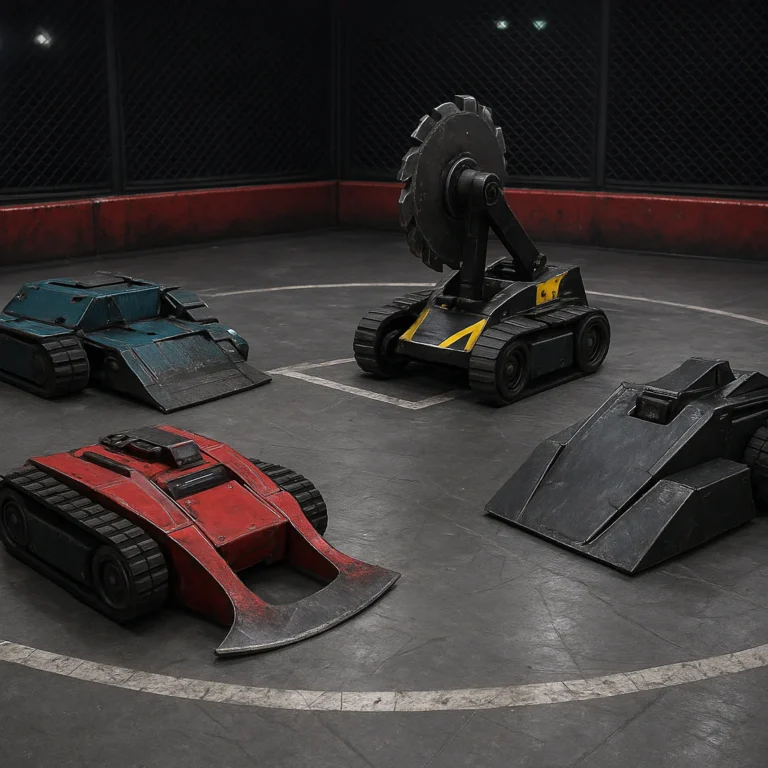
- Spinners (The Rock): Whether vertical or horizontal, these bots rely on kinetic energy. A well-timed hit can shatter armor.
- Pros: Devastating offense, can disable weapons.
- Cons: Self-destructive, hard to control, often self-entangle.
- Wedges/Plows (The Paper): Designed to slide under opponents and lift them or push them out.
- Pros: Reliable, hard to defeat if the angle is right, great for sumo.
- Cons: Low offense, can be flipped by spinners.
- Flippers/Crushers (The Scissors): These bots use hydraulics or pneumatics to flip opponents or crush them against the wall.
- Pros: High control, can end matches instantly.
- Cons: Slow cycle time, complex mechanics.
Here’s the kicker: A spinner might destroy a wedge, but a wedge can easily push a spinner out of the arena if the spinner misses. So, how do you build a bot that covers all bases? That’s where modular design comes in, a concept we’ll explore with Peter Lombardo.
💻 Phase 2: Engineering the Ultimate Athlete – Design and CAD Mastery
Once you have your concept, it’s time to bring it to life in the digital realm. CAD (Computer-Aided Design) is your sandbox. This is where you simulate the chaos before the first bolt is tightened.
🛡️ Jonathan Schultz’s Masterclass: Designing for Durability and Impact Resistance
Jonathan Schultz, a veteran engineer in the field, always says, “If it doesn’t break, it’s not a robot; it’s a statue.” But the goal isn’t to break easily; it’s to break predictably.
- Stress Analysis: Use FEA (Finite Element Analysis) in your CAD software to identify stress concentration points. Where will the impact hit? Reinforce those areas with gussets or thicker material.
- Sacrificial Parts: Design your bot so that non-critical parts (like side panels or sensor mounts) absorb the initial blow. This protects the chassis and electronics.
- The “Self-Destruct” Mechanism: Some teams intentionally design weak points in their own armor to allow the bot to shed weight or change shape after a massive hit, turning a disadvantage into a tactical shift.
🧩 Peter Lombardo’s Guide to Modular Chassis and Frame Integrity
Peter Lombardo champions the modular chassis. Why build a robot that takes 4 hours to repair when you can swap a module in 10 minutes?
- Standardized Mounting: Use DIN rails or modular aluminum extrusions (like 80/20) for your internal frame. This allows you to move batteries, motors, or controllers quickly.
- Weapon Independence: Ensure your weapon system is mounted on a separate sub-frame. If the weapon shatters, you can remove it and continue fighting with a “naked” chassis.
- Cable Management: Use zip ties, heat shrink, and conduit to protect wires. A loose wire in a high-vibration environment is a time bomb.
📍 Garrett Santoline’s Secrets to Weight Distribution and Center of Gravity
Garrett Santoline is the master of physics. He knows that a 3 kg robot with a high center of gravity is a tipping hazard.
- Low and Wide: Keep heavy components (batteries, motors) as low and wide as possible. This increases stability and makes it harder for opponents to flip you.
- Symmetry is Key: Asymmetrical weight distribution can cause your robot to pull to one side, making driving a nightmare. Always balance your left and right sides.
- The Magnet Math: If you are using magnets for sumo, calculate the center of magnetic force. If it’s too far forward, you might get stuck on the edge. If it’s too far back, you might not be able to push.
You’ve got the frame, but what powers it? A beautiful chassis is useless without the right heart. Let’s talk about the guts that make these machines move.
🔋 Phase 3: The Guts and Glory – Internal Systems and Electronics
The brain and heart of your robot are just as important as its muscles. In the heat of battle, voltage drops and signal loss can be the difference between a victory and a DQ.
⚡ Don Doerfler’s High-Voltage Secrets: Batteries and Speed Controllers
Don Doerfler knows that power density is king. You need a battery that can deliver massive current without sagging.
- LiPo vs. Li-ion: For high-power applications, LiPo (Lithium Polymer) batteries are the standard due to their high discharge rates (C-rating). However, Li-ion packs offer better energy density for longer matches.
- Speed Controllers (ESCs): Choose ESCs rated for at least 20% more current than your motors will draw. A 60A motor needs an 80A ESC. Don’t skimp here; a blown ESC means a dead bot.
- Battery Management Systems (BMS): Always use a BMS to prevent over-discharge. A dead battery mid-match is a guaranteed loss.
🔌 Maddie Thumma’s Wiring Wisdom: Avoiding the Dreaded Magic Smoke
Maddie Thumma has seen it all: sparks, smoke, and melted plastic. Her advice? Organize and insulate.
- Wire Gauge: Use the correct AWG (American Wire Gauge) for your current. Too thin, and you’ll have voltage drop and heat. Too thick, and you’re adding unnecessary weight.
- Connectors: Use XT60 or AS150 connectors for high-current connections. They are reliable and easy to swap.
- Shielding: In a sea of motors and weapons, EMI (Electromagnetic Interference) is real. Shield your sensor wires and use twisted pairs for signal lines to prevent noise from ruining your control.
But what good is a powerful bot if it can’t hit hard? It’s time to unleash the weapon.
⚔️ Phase 4: Weaponry and Offense – Bringing the Pain
This is where the rubber meets the road. Your weapon is your primary tool for victory. Whether it’s a spinning bar or a hydraulic flipper, it needs to be lethal.
🌪️ Brendan Steele’s Kinetic Energy Calculations for Vertical Spinners
Brendan Steele is a math wizard when it comes to kinetic energy. The formula $KE = 0.5 \times m \times v^2$ is your bible.
- Mass vs. Velocity: Doubling the mass doubles the energy, but doubling the velocity quadruples the energy. This is why high-speed spinners are so devastating.
- Moment of Inertia: A heavy rim on your spinner increases the moment of inertia, allowing it to store more energy and resist slowing down upon impact.
- Material Choice: Use titanium or steel for the weapon itself. Aluminum is too soft and will deform after a few hits.
💥 Joe Doerfler’s Hydraulic and Pneumatic Power Plays
Joe Doerfler prefers the controlled violence of hydraulics and pneumatics.
- Hydraulics: Offer massive force and are great for flippers and crushers. They are slower but deliver sustained pressure.
- Pneumatics: Faster cycle times, perfect for quick strikes. However, they require a compressor and can be less consistent in force.
- Safety First: High-pressure systems can be dangerous. Always include pressure relief valves and safety shields to protect your team and the audience.
You’ve got the weapon, but will it survive the first hit? That brings us to the materials that make or break your armor.
🛠️ Phase 5: Material Science – Choosing the Right Armor and Alloys
Your robot is a tank. It needs armor that can take a beating. Choosing the right material is a balance of weight, strength, and cost.
🔩 AR500 vs. Titanium: Which Metal Survives the Meat Grinder?
- AR500 Steel: The gold standard for impact resistance. It’s hard, durable, and relatively cheap. However, it’s heavy.
- Titanium: The lightweight champion. It has an excellent strength-to-weight ratio but is expensive and harder to machine.
- Aluminum (7075-T6): A good middle ground. Lighter than steel, stronger than 6061, but can still dent under heavy impact.
| Material | Density | Strength | Cost | Best Use |
|---|---|---|---|---|
| AR500 Steel | High | Very High | Low | Armor, Weapons |
| Titanium | Low | High | High | Chassis, Arms |
| Aluminum 7075 | Medium | Medium-High | Medium | Frames, Mounts |
| UHMW Plastic | Low | Low | Low | Skids, Wedges |
🧶 The Rise of Composites: Carbon Fiber and UHMW in the Ring
- Carbon Fiber: Incredible stiffness and lightness. Great for chassis and arms, but can be brittle under direct impact.
- UHMW (Ultra-High Molecular Weight Polyethylene): The secret weapon for skids and wedges. It’s self-lubricating, incredibly tough, and won’t dent. It’s the material of choice for sumo plows.
With the perfect materials and weapons, how do you actually win the match? It’s not just about the hardware; it’s about the strategy.
🎮 Phase 6: The Art of War – Competition Strategy and Tactics
You can have the best robot in the world, but if you drive like a drunk driver, you’ll lose. Strategy is the invisible hand that guides your bot to victory.
🕵️ Scouting the Opposition: Analyzing Weak Points and Armor Gaps
Before every match, watch the opponent’s previous fights. Look for:
- Exposed Electronics: Are their wires hanging out?
- Weak Armor: Is there a dent that looks like it will break?
- Driving Habits: Do they always turn left? Do they get stuck on bumps?
🏎️ Driving Skills: The Difference Between Winning and Whirring
- Angle of Attack: Always approach your opponent at an angle that maximizes your wedge or spinner effectiveness.
- The Bump Trap: As discussed in the rules, trapping an opponent on a bump is a valid and powerful strategy. Use your sensors to detect the edge and force them into a corner.
- Adaptability: If your plan A fails, switch to plan B. If your spinner is broken, become a pusher. Flexibility is key.
But what happens when the match ends and your bot is a pile of scrap? That’s where the real work begins.
🔧 Phase 7: The Pit Crew Mentality – Maintenance and Rapid Repairs
The match is over, but the work isn’t. In a tournament, you might have 10 minutes to fix your bot for the next round. You need a pit crew mentality.
- Pre-Match Checklist: Always check battery voltage, motor connections, and weapon integrity before every match.
- Spare Parts: Bring extra wheels, motors, sensors, and wires. You never know what will break.
- Rapid Repair Techniques: Use zip ties, duct tape, and super glue for quick fixes. Sometimes a temporary fix is better than no fix.
- Team Roles: Assign specific roles: one person for electronics, one for mechanical, one for driving. Efficiency is everything.
Now that you have the design, the strategy, and the repair skills, are you ready to step into the ring? The answer lies in the details we’ve uncovered, but the journey is just beginning. Stay tuned for our conclusion and a deep dive into the resources that will make you a champion.
🏁 Conclusion

So, you’ve made it to the end of the blueprint. You’ve learned that effective weight in sumo can be more valuable than raw horsepower, that LiDAR is the eyes of the autonomous champion, and that a modular chassis is the lifeline of a surviving team. Remember the question we asked earlier: Can a robot be designed to cover all bases? The answer is a resounding yes, but only through specialization and adaptability.
There is no single “perfect” robot. The spinner that dominates the arena one week might be outmaneuvered by a wedge the next. The magnetized sumo bot that pushes giants aside can be neutralized by a team that exploits the bump trap loophole. The secret to victory isn’t just in the kinetic energy calculations or the AR500 steel armor; it’s in the team’s ability to pivot.
Our Confident Recommendation:
If you are just starting, do not try to build a complex autonomous spinner immediately. Start with a simple, robust wedge in the 3 kg class. Master the driving skills and the magnet physics first. As you gain experience, integrate modular weapon systems and advanced sensors. The path to the Robot Wrestling League is paved with failed prototypes and rapid repairs, not perfection on the first try.
- ✅ Do: Focus on weight distribution, modular repair, and scouting opponents.
- ❌ Don’t: Ignore the rules regarding trapping, skimp on wire shielding, or rely on a single weapon archetype.
The arena awaits. Will you be the one pushing the opponent out, or the one stuck on the bump? The choice is yours, and the tools are in your hands. Now, go build something that roars.
🔗 Recommended Links
Ready to start building? Here are the essential tools, components, and resources we recommend for your robot wrestling journey.
🛒 Essential Components & Tools
- High-Performance LiPo Batteries:
- 👉 Shop on: Amazon | BatterySpace
- AR500 Steel Armor Plates:
- 👉 Shop on: Amazon | AR500Armor
- Teensy Microcontrollers (For Autonomous Logic):
- 👉 Shop on: Amazon | PJRC
- LiDAR Sensors (Obstacle Detection):
- 👉 Shop on: Amazon | RPLiDAR Official
- Heavy-Duty Servos and Motors:
- 👉 Shop on: Amazon | Pololu
- UHMW Plastic Sheets (For Skids/Wedges):
- 👉 Shop on: Amazon | McMaster-Carr
📚 Must-Read Books & Guides
- “Make: Robotics” by Simon Monk: A comprehensive guide to the fundamentals of robot construction.
- Check Price on Amazon
- “Robotics: A Very Short Introduction” by Alan Winfield: Perfect for understanding the theoretical underpinnings of autonomous systems.
- Check Price on Amazon
- “The Art of Electronics” by Horowitz and Hill: The bible for anyone dealing with the electronics of high-voltage robot systems.
- Check Price on Amazon
❓ FAQ

What are the most common weapon types used in robot wrestling designs?
Robot wrestling designs generally fall into three primary categories, each with distinct tactical advantages:
- Spinners (Vertical & Horizontal): These rely on kinetic energy ($KE = 0.5 \times m \times v^2$). Vertical spinners are excellent for flipping opponents, while horizontal spinners (like “slicers”) are designed to shred armor.
- Wedges and Plows: These are purely defensive and pushing-oriented. They slide under opponents to lift them or push them out of the arena. In sumo-style competitions, these are often combined with magnets for maximum traction.
- Flippers and Crushers: These use hydraulics or pneumatics to apply massive force over a short distance, either flipping an opponent or crushing them against the wall.
Read more about “🤖 Automated Wrestling Robots: 15 Game-Changing Design Secrets (2026)”
How do teams calculate torque and weight distribution for their robots?
Calculating torque is critical for ensuring your robot can push an opponent. The formula is $Torque = Force \times Distance$. Teams must calculate the tractive force required to overcome the opponent’s friction (which is increased by magnets in sumo) and the gear ratio of their drivetrain.
- Weight Distribution: Engineers use CAD software with FEA (Finite Element Analysis) to simulate the robot’s center of gravity (CoG). The goal is to keep the CoG low and centered to prevent tipping. In sumo, the magnetic center must align with the geometric center to ensure even adhesion.
Read more about “Ultimate Guide to Robot Design for Battle (2025) 🤖”
What safety regulations must robot wrestling competitors follow?
Safety is paramount. Most leagues, including the Robot Wrestling League, enforce strict rules:
- Remote Kill Switch: All robots must have a functioning kill switch that cuts power immediately.
- Weapon Containment: Spinning weapons must be fully enclosed or shielded to prevent debris from flying into the audience.
- Battery Safety: LiPo batteries must be housed in fireproof bags or containers.
- Arena Integrity: Robots must not be able to breach the arena walls or damage the safety glass.
- Pit Safety: Teams must wear safety glasses and gloves when working on live robots.
How do engineers choose between hydraulic and electric drive systems?
The choice depends on the power-to-weight ratio and control precision required:
- Hydraulics: Preferred for flippers and crushers where massive, sustained force is needed. They are heavier and require a pump, but they offer incredible torque.
- Electric: Preferred for drivetrains and spinners where speed and responsiveness are key. Electric motors are lighter, easier to control with ESCs, and have fewer failure points (no leaks).
- Hybrid: Some advanced bots use electric drives for movement and hydraulics for weapons.
What strategies do teams use to counter specific opponent weaknesses?
- Against Spinners: Use a low-profile wedge to get underneath the spinner before it can build up speed, or use side armor to deflect the hit.
- Against Wedges: Attack from the side or rear where the wedge is ineffective, or use a spinner to flip the wedge.
- Against Autonomous Bots: Exploit their sensor blind spots or force them into bump traps where their logic fails.
- The “Bump Trap”: As noted in the rules, trapping an opponent on a field bump is a legal and effective strategy to neutralize aggressive bots.
How much does it typically cost to build a competitive robot wrestler?
Costs vary wildly based on the weight class and materials:
- Antweights/Beetleweights: Can be built for $200 – $500 using off-the-shelf parts.
- Sumo (3kg): Typically ranges from $500 – $1,500, heavily influenced by the cost of magnets and LiDAR.
- Heavyweights: Can easily exceed $5,000 – $10,000+ due to the cost of titanium, hydraulics, high-voltage batteries, and custom machining.
Read more about “🤖 Robot Combat League: 12 Legends & The 2026 Comeback”
What materials are best for armor plating in robot battles?
- AR500 Steel: The industry standard for impact resistance. It’s hard, affordable, and absorbs energy well.
- Titanium (Grade 5): Excellent for weight-critical applications where high strength is needed. It’s expensive but offers the best strength-to-weight ratio.
- UHMW Plastic: Ideal for skids and wedges due to its low friction and high abrasion resistance.
- Carbon Fiber: Great for chassis and arms where stiffness is required, but it can be brittle under direct impact.
How do teams manage rapid repairs between matches?
Teams maintain a “pit kit” containing spare motors, wheels, wires, connectors, and adhesives (like super glue and duct tape). They use modular designs to swap out entire sub-assemblies (like a weapon mount) in under 5 minutes.
What role does software play in modern robot wrestling?
Software is becoming increasingly critical, especially for autonomous robots. It handles sensor fusion (combining LiDAR, IMU, and line sensor data), path planning, and decision-making. In human-controlled bots, software manages motor smoothing and weapon timing.
Read more about “How Do Robot Wrestling Teams Design & Test for Max Performance? 🤖 (2026)”
📚 Reference Links
For those who want to dive deeper into the engineering and history of robot wrestling, these are the authoritative sources we relied on:
- RoboJackets – Introducing the RoboWrestling Robots: A deep dive into the design of “Gucci” and “Kirbii,” featuring details on magnet arrays, LiDAR, and Teensy microcontrollers.
- Read the full article here
- Chief Delphi – FRC Q&A on Trapping Rules: Official clarification on the legality of trapping robots on field bumps and the strategic implications.
- View the discussion here
- Robot Wrestling League Official Rules: The definitive guide to scoring, weight classes, and safety regulations.
- Visit the official site
- Pololu – Robotics Components: A leading supplier of motors, sensors, and controllers used by top teams.
- Explore Pololu Products
- Amazon.com – AR500 Steel Products: For sourcing the most common armor material used in the sport.
- Search for AR500 Steel
- Teensy by PJRC: The microcontroller platform of choice for high-speed autonomous logic.
- Visit the Teensy Official Site