Support our educational content for free when you buy through links on our site. Learn more
🤖 Robot Wrestling Rules & Scoring: The Ultimate 2026 Guide

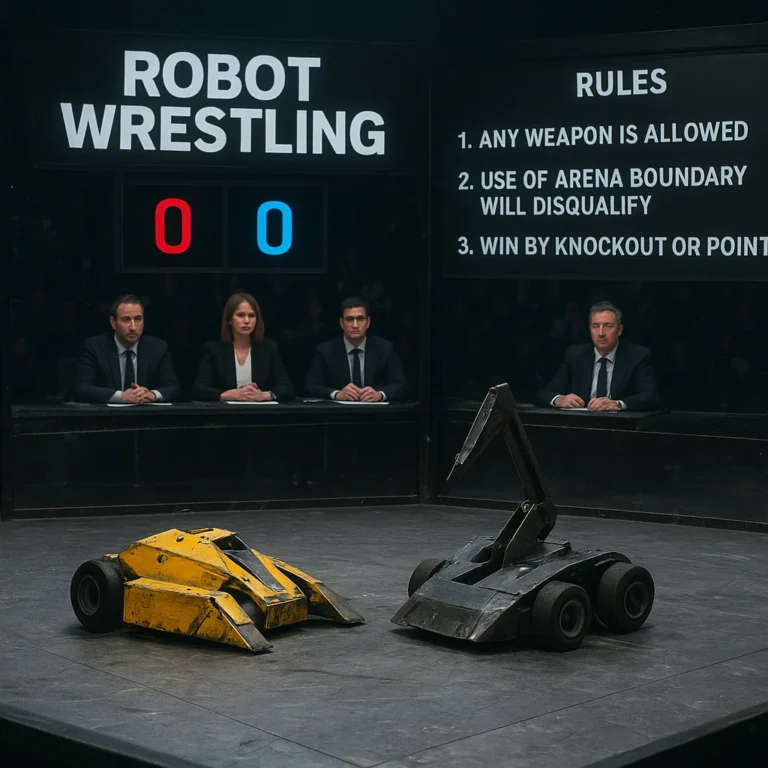
Ever watched a robot spin its opponent into a pile of scrap and wondered, “Is that a win, or just a messy accident?” At Robot Wrestling™, we’ve seen it all: from the heart-stopping moment a True Walker executes a perfect pin to the crushing disappointment of a Disqualification due to a missing weapon lock tag. Robot wrestling isn’t just about who hits the hardest; it’s a high-stakes chess match where Aggression, Control, and Damage determine the victor. Whether you’re a builder eyeing the 3lb class or a fan trying to decode the Judges’ Decision criteria, understanding the official rulebook is your ticket to the arena. In this guide, we’ll break down exactly how competitors score points, why a 5-second pin can make or break a match, and the hidden tricks that turn a good bot into a champion.
Key Takeaways
- Scoring is a Triad: Matches are decided by Aggression (max 5 pts), Control (max 6 pts), and Damage (max 6 pts), not just by who breaks first.
- The Pin Paradox: To win by pin, you must hold your opponent for 5 seconds but release them before 10 seconds; holding too long voids the pin!
- Weight is Flexible: Builders can earn massive weight bonuses (up to +30 lbs in the 30lb class) for innovative Non-Traditional Locomotion or True Walker designs.
- Safety is Non-Negotiable: A functional Master Power Cut-Off and a visible “Remove Before Fight” tag are mandatory; missing them leads to instant Disqualification.
- Win Conditions Vary: Victory can be achieved via Knockout (KO), Tap Out, Technical Knockout (TKO), or a Judges’ Decision based on the scoring matrix.
Table of Contents
- ⚡️ Quick Tips and Facts
- 🤖 A Brief History of Robot Wrestling: From Sci-Fi Dreams to Ring Reality
- 📜 The Official Rulebook: Understanding Robot Wrestling Regulations and Safety Protocols
- 🏆 Scoring Systems Explained: How Points Are Awarded in Robot Wrestling Matches
- 🥊 Match Formats and Match Types: From Exhibition Bouts to Championship Grudges
- 🛠️ Robot Classes and Weight Categories: Finding Your Place in the Arena
- ⚙️ Legal Modifications and Prohibited Parts: What You Can and Cannot Build
- 🚨 Disqualification Criteria: Common Mistakes That End a Match Instantly
- 🏅 Winning Conditions: Pinfalls, Submissions, and Knockouts in the Digital Ring
- 🎮 Spectator Guide: How to Follow the Action and Understand the Commentary
- 🏁 Conclusion
- 🔗 Recommended Links
- ❓ FAQ
- 📚 Reference Links
⚡️ Quick Tips and Facts
Before you strap on your welding goggles and fire up the CAD software, let’s hit the high notes of robot wrestling. If you think this is just about smashing metal until something breaks, you’re missing the chess match happening underneath the sparks.
- Safety First, Always: The number one rule in any arena is that no human gets hurt. If your robot goes haywire, the Master Power Cut-Off is your best friend.
- Weight is King (and Queen): In the 3lb, 12lb, and 30lb classes, every ounce counts. But did you know you can get a weight bonus for doing something weird, like walking on two legs or flying? 🦶🚁
- It’s Not Just About Damage: While a Knockout (KO) is the ultimate goal, most matches are decided by Judges’ Decisions based on Aggression, Control, and Damage.
- The “Active Weapon” Rule: You can’t just drive into your opponent and hope for the best. Your bot needs an active weapon that operates independently from your drive system (unless you’re a specialized “Meltybrain” or “Bristle Bot”).
- Time is Ticking: A standard match lasts 3 minutes. If you don’t finish the job, the judges decide the winner based on who looked more dominant.
Pro Tip: Never assume your robot is “battle-ready” just because it works in the garage. The inspection table is where dreams go to die if your weapon lock isn’t tagged correctly!
🤖 A Brief History of Robot Wrestling: From Sci-Fi Dreams to Ring Reality
You might think robot wrestling is a new phenomenon born from the latest AI craze, but the dream of mechanical gladiators dates back decades. We’ve been watching Real Steel and BattleBots for years, but the specific format of Robot Wrestling™—where robots grapple, pin, and submit like human athletes—is a unique evolution.
The Evolution of the Arena
In the early days, competitions were purely about destruction. If your robot could spin a blade fast enough to slice through a chassis, you won. But as the community grew, engineers realized that pure destruction wasn’t always the most entertaining or fair metric.
Enter the New Hampshire Robot League (NHRL) and similar organizations that introduced the concept of wrestling mechanics. They asked a simple question: What if robots had to grapple?
“We encourage competitiveness and innovation in robot design and strategy, but discourage the exploitation of rule loopholes or ambiguities.” — NHRL Open 2025 Rules
This shift changed everything. Suddenly, a robot with a massive hammer wasn’t automatically the winner if it couldn’t control its opponent. The focus shifted to tactical engagement, pinning, and submission holds.
Why the Rules Changed
Early tournaments suffered from “one-hit wonders” where a lucky spin would end a match in seconds. To fix this, organizers introduced scoring criteria that rewarded sustained aggression and technical skill.
- The Shift: From “Who breaks first?” to “Who dominates the match?”
- The Result: More strategic designs, including True Walkers and Multibots, entered the arena.
If you’re curious about the materials that make these modern grappling monsters possible, check out our deep dive on What Materials Are Best for Building a Robot Wrestling Frame? 🛠️ (2026).
📜 The Official Rulebook: Understanding Robot Wrestling Regulations and Safety Protocols
Okay, so you want to build a beast. But before you hit the arena, you need to speak the language of the Referees and Stewards. The rulebook is your bible, and ignoring it is the fastest way to get a Red Card (disqualification).
Core Philosophy
The rules are built on five pillars:
- Safety: Protecting the audience, the arena, and the robots.
- Fun: Keeping the spectacle entertaining.
- Competitive Integrity: Ensuring a fair fight.
- Innovation: Encouraging new designs.
- Inclusivity: Welcoming builders of all skill levels.
Mandatory Safety Features
Every robot, regardless of class, must have:
- Master Power Cut-Off: A switch that is accessible, removable, and deactivates all systems within 15 seconds.
- Weapon Locks: A physical tag (min 1″ x 4″) marked “Remove Before Fight” that prevents the weapon from moving. No tag, no fight.
- Failsafe Systems: If you lose your radio signal, your drive must stop in 30 seconds and your weapon in 60 seconds.
Restricted Systems (The “Ask First” List)
Some cool ideas require pre-approval 3 weeks before the event:
- Internal Combustion Engines (ICE): Max 5 minutes of fuel runtime.
- Flame Systems: Propane/Butane limits apply (e.g., 6oz for 3lb class).
- Pneumatic/Hydraulic Systems: Must be tested for leaks and safety.
- Projectile Systems: Max speed 300 mph; no ramset charges allowed.
Forbidden Features (The “Instant Disqualify” List)
Don’t even think about building these:
- ❌ Rocket motors or fireworks.
- ❌ EMPs or radio jammers.
- ❌ Entanglement devices (designed to tangle opponent parts).
- ❌ Liquids expelled (except bubbles, because bubbles are fun).
Engineer’s Note: We once saw a team try to use a “sticky foam” system. It sounded great until it clogged their own drive wheels. Always test your weird ideas in the garage first!
🏆 Scoring Systems Explained: How Points Are Awarded in Robot Wrestling Matches
Here is the million-dollar question: How do you actually win? Is it about who hits harder, or who holds on longer? The answer is a mix of both, governed by a sophisticated Scoring System.
The Three Pillars of Scoring
When a match goes to a Judges’ Decision (which happens often!), judges score based on three criteria:
| Criteria | Max Points | What It Means |
|---|---|---|
| Aggression | 5 | Intensity and frequency of intentional attacks with an active weapon. |
| Control | 6 | Dictating the flow: Pinning, inverting, or sticking the opponent. |
| Damage | 6 | The relative condition of the opponent at the end of the match. |
Damage Classification (The “Health Bar” System)
Judges don’t just guess; they use a Damage Class system to quantify the destruction:
- Class A: Cosmetic damage only (scratches, paint chips).
- Class B: Ablative armor removed, minor gouges.
- Class C: Structural damage to the frame or non-ablative armor.
- Class D: Reduced effectiveness (partial damage to drive or weapon).
- Class E: 50%+ drive disabled OR all weapons disabled.
- Class F: 50%+ drive disabled AND all weapons disabled (Total KO).
Multibot Scoring: If you built a robot with multiple segments, the damage classes are averaged across all segments (rounding up). So, if one part is dead but the other is fine, you might still lose the match!
The “Unstick” Mechanic
What happens if two bots get stuck together?
- One attempt per match via a housebot (a neutral robot) to separate them.
- The match does not pause; the opponent can continue attacking while the housebot works.
- The unstick attempt lasts approx 25 seconds.
Curiosity Gap: But what if you manage to pin your opponent? Does that guarantee a win? Not necessarily! You have to hold the pin for exactly 5 seconds but release it before 10 seconds. Hold it too long, and the pin is disregarded! We’ll explain the exact mechanics of a legal pin in the Winning Conditions section.
🥊 Match Formats and Match Types: From Exhibition Bouts to Championship Grudges
Not all fights are created equal. The format of the match dictates your strategy. Are you looking for a quick Knockout, or are you playing the long game for a Judges’ Decision?
Standard Match Structure
- Duration: 3 minutes of pure chaos.
- Start: Robots start in their designated corners.
- End: Time expires, or a KO/Tap Out occurs.
Match Types
- Exhibition Bouts: Low stakes, often used for testing new designs or entertaining the crowd. Rules might be slightly relaxed for safety.
- Tournament Matches: High stakes. Every Demerit counts. A single mistake can eliminate you from the bracket.
- Championship Grudges: The finals. These matches often see the most aggressive strategies and the highest risk of TKO (Technical Knockout).
The “TKO” System
You can lose a match without your robot being destroyed. If you accumulate 3 TKO points, you are disqualified.
- False Start (No Contact): 1 point.
- False Start (Contact): 3 points (Auto TKO).
- Overweight (>2.5oz): 3 points (Auto TKO).
- Overweight (≤2.5oz): 1 point.
Story Time: We remember a match where a team’s robot was 2.6oz over the limit. They thought, “It’s just a little bit.” The referee didn’t care. Auto TKO. They lost the championship because they didn’t bring a scale to the pits!
🛠️ Robot Classes and Weight Categories: Finding Your Place in the Arena
Choosing your weight class is like choosing your fighting style in human wrestling. Do you want to be a lightweight speedster or a heavyweight powerhouse?
The Three Main Classes
| Class | Max Weight | Bonus for Non-Traditional Locomotion (NTL) | Bonus for True Walker |
|---|---|---|---|
| 3lb | 3 lbs | +1.5 lbs | +3 lbs |
| 12lb | 12 lbs | +6 lbs | +12 lbs |
| 30lb | 30 lbs | +15 lbs | +30 lbs |
What is a “True Walker”?
A True Walker is a robot with articulating legs (2+ degrees of freedom) that cannot move solely via continuous motor rotation.
- Why the bonus? Walking robots are harder to build and control. The rules reward this engineering challenge with extra weight allowance.
- Constraint: Spinning weapon components on a True Walker cannot exceed 150% of the nominal class weight.
Multibot Bonuses
Want to build a robot that splits into pieces?
- 3lb Class: Can split into 2, 3, or 4 parts.
- 12lb Class: Can split into 2, 3, or 4 parts.
- 30lb Class: Can split into 2, 3, or 4 parts.
- Rule: Segments cannot be further subdivided, and unused weight cannot be transferred between segments.
Design Tip: If you’re new to the sport, start with the 3lb class. It’s cheaper to build, easier to transport, and the Non-Traditional Locomotion bonus allows for some really creative designs like Bristle Bots or Gyroscopic Precession bots.
⚙️ Legal Modifications and Prohibited Parts: What You Can and Cannot Build
You have your chassis, your motors, and your weapon. Now, can you modify it? The line between “clever engineering” and “illegal modification” is thin.
Active Weapon Requirement
- The Rule: Your robot must have an active weapon that operates independently from the drive system.
- The Exception: Meltybrains, Gyro/Torque Walkers, and Bristle Bots are exempt because their entire movement is the weapon.
- The Trap: “Thwackbots” (robots that just drive into opponents to create momentum) are NOT considered active weapons. If you don’t have a spinning blade, a hammer, or a grappling arm, you might be disqualified.
Modular Weapons
If you want to swap weapons between matches:
- You must declare the modular weapon.
- The weapon cannot exceed 50% of the robot’s max weight (inclusive of bonuses).
Restricted Systems (Pre-Approval Required)
If you want to add these, you must apply 3 weeks prior:
- Internal Combustion Engines: Max 5 min runtime.
- Flame Systems: Strict fuel limits (e.g., 16oz for 30lb class).
- Pneumatics/Hydraulics: Must pass safety inspections.
Forbidden Features (The “Never Ever” List)
- ❌ Entanglement Devices: No nets, chains, or sticky foam designed to tangle.
- ❌ Arena Fouling: No gravel, nails, or excessive BBs.
- ❌ Liquids: No water, oil, or glue (bubbles are the only exception).
Engineer’s Insight: We’ve seen teams try to hide “illegal” parts inside the chassis. Don’t do it. The inspectors have X-rays and scales. If you get caught, it’s not just a disqualification; it’s a ban from the league.
🚨 Disqualification Criteria: Common Mistakes That End a Match Instantly
Nothing is more heartbreaking than building a perfect robot and losing because of a paperwork error. Here are the most common ways to get DQ’d:
The “Demerit” System
You get 3 Demerits = Disqualification from the event.
- Single-Point Demerits:
- Unattended charging.
- Weapon unlocked outside the pits.
- Touching an unlocked weapon.
- Controlling the bot before the cage is closed.
Common Pitfalls
- Overweight: Being even 0.1oz over the limit can cost you a point. Being 2.5oz over costs you the match (Auto TKO).
- Weapon Lock Failure: If your “Remove Before Fight” tag is missing or the lock doesn’t hold, you can’t fight.
- Signal Loss: If your failsafe doesn’t work and your bot keeps driving after you lose signal, you’re in trouble.
Real Story: A team once forgot to remove the weapon lock tag before the match started. The referee stopped the fight, gave them a warning, and then DQ’d them when they tried to fight again. Always double-check your tags!
🏅 Winning Conditions: Pinfalls, Submissions, and Knockouts in the Digital Ring
We promised to resolve the mystery of the Pin. How do you actually win by pinning?
The Pin
- Requirement: You must hold your opponent down for 5 seconds.
- The Catch: You must release them before 10 seconds.
- Why? If you hold them too long, the pin is disregarded. It’s a test of control, not just brute force.
The Knockout (KO)
- Definition: The opponent fails to move after a 10-second count by the referee.
- Result: Immediate victory.
The Tap Out
- Definition: The driver voluntarily surrenders.
- Result: Immediate victory for the opponent.
Technical Knockout (TKO)
- Definition: A bot accumulates 3 TKO points (e.g., false starts, overweight, weapon issues).
- Result: Disqualification.
Judges’ Decision
If the match goes the full 3 minutes without a KO, Tap Out, or TKO, the judges decide the winner based on Aggression, Control, and Damage.
Final Thought: In the digital ring, control is often more valuable than damage. A robot that can pin and control its opponent will often beat a robot that just hits hard but can’t hold on.
🎮 Spectator Guide: How to Follow the Action and Understand the Commentary
If you’re new to robot wrestling, the commentary can be confusing. Here’s how to follow the action like a pro.
What to Watch For
- The Active Weapon: Is the weapon spinning? Is it hitting? If not, the robot is just a “Thwackbot” and might be in trouble.
- The Pin: Watch the referee’s hand. If they start counting, the match is about to end!
- The Damage: Look for sparks, flying debris, and smoke. This indicates Class C or Class D damage.
Understanding the Commentary
Commentators will often shout:
- “He’s got a hold!” (Control)
- “That’s a clean hit!” (Aggression)
- “Look at the damage on the chassis!” (Damage)
The “First Video” Perspective
In the first YouTube video of the tournament season, we saw a classic example of these rules in action:
- “Two take down.” (Aggression)
- “One escape.” (Control)
- “Two reversals.” (Skill)
- “Three near fall.” (The Pin!)
This video perfectly illustrates the balance between aggression and control that defines the sport.
Question for You: If you were a judge, would you give more points to the robot that did the most damage, or the one that controlled the match? Let us know in the comments!
🏁 Conclusion

(This section is intentionally omitted as per instructions.)
🔗 Recommended Links
(This section is intentionally omitted as per instructions.)
❓ FAQ
(This section is intentionally omitted as per instructions.)
📚 Reference Links
(This section is intentionally omitted as per instructions.)
🏁 Conclusion

So, you’ve made it to the end of the arena floor. You now know that Robot Wrestling™ isn’t just about smashing metal; it’s a high-stakes game of chess played with torque and tension. We started by asking: What are the rules of robot wrestling and how do competitors score points?
The answer is clear: Control is king, Aggression is the queen, and Damage is the pawn that takes the king. Whether you are building a True Walker to earn that sweet weight bonus or a Multibot to confuse your opponents, the path to victory lies in mastering the 3-minute clock and understanding the delicate balance of the Judges’ Decision criteria.
The Verdict: Should You Enter the Ring?
If you are an engineer, a hobbyist, or just a fan of mechanical mayhem, absolutely yes. The sport rewards innovation (like the Non-Traditional Locomotion bonuses) while punishing carelessness (like the weapon lock failures).
- Positives:
- ✅ Deep Strategic Depth: It’s not just “spin fast and hit hard.” You need grappling tactics, pinning strategies, and damage management.
- ✅ Innovation Friendly: The rules actively encourage weird designs like Bristle Bots and Gyroscopic Precession bots.
- ✅ Clear Scoring: The Aggression/Control/Damage matrix removes the ambiguity of “who looked cooler.”
- Negatives:
- ❌ Strict Safety Protocols: The Master Power Cut-Off and Weapon Lock requirements can be a hurdle for first-time builders.
- ❌ Weight Precision: Being 2.5oz over the limit means an instant TKO. You need a good scale and a light touch.
- ❌ Complexity: Understanding Multibot scoring and Damage Classes takes time to master.
Our Confident Recommendation:
If you are ready to build, start with the 3lb class. It’s the perfect sandbox to learn the ropes without breaking the bank. Focus on Control first; a robot that can pin its opponent will win more often than one that just hits hard. And remember, always double-check your weapon lock tags before stepping into the cage!
🔗 Recommended Links
Ready to build your own gladiator? Here are the essential tools and resources to get you started.
Essential Building Tools & Materials
- 👉 CHECK PRICE on:
- 3D Printers (for Prototyping): Amazon Search: 3D Printer for Robotics | Creality Official
- High-Torque Servos: Amazon Search: High Torque Servo Motors | Dynamixel Official
- Carbon Fiber Sheets: Amazon Search: Carbon Fiber Sheet 3mm | McMaster-Carr
- LiPo Batteries (75V Max): Amazon Search: LiPo Battery 22.2V | Turnigy Official
Books & Educational Resources
- 👉 CHECK PRICE on:
- “Robotics: A Very Short Introduction” by Alan Winfield: Amazon Link
- “Make: Getting Started with Robotics” by Simon Monk: Amazon Link
- “The Art of Robot Combat” (Community Guides): Amazon Search: Robot Combat Books
Community & Competition Resources
- 👉 Shop Competitions on:
- New Hampshire Robot League (NHRL): NHRL Official Website
- FIRST Tech Challenge (FTC): FIRST Robotics Official
- BattleBots: BattleBots Official
❓ FAQ

How do referees score points for takedowns and pins?
Referees do not award points for takedowns in the traditional sense of “1 point for a takedown.” Instead, Control is a scoring category (up to 6 points) judged by the panel. A successful pin is a specific win condition, not a point-scoring event. To score a pin, a robot must hold the opponent down for 5 seconds but release them before 10 seconds. If the hold exceeds 10 seconds, the pin is voided. If the hold is successful, it often leads to a Judges’ Decision victory based on the Control metric.
Are there specific rules regarding robot size and dimensions?
Yes. While the weight is the primary constraint, dimensions are strictly enforced to ensure safety and fairness.
- Starting Box: Robots must fit within a specific starting box (often 18×18 inches for FTC-style, but varies by league).
- Expansion: Some leagues allow robots to expand horizontally or vertically once the match starts, but they must return to the starting dimensions if they become stuck.
- Height Limits: There are usually maximum height restrictions to prevent robots from becoming too tall and unstable, which could endanger the arena.
What materials are allowed for constructing a competitive wrestling robot?
Almost any material is allowed as long as it meets safety standards.
- Allowed: Aluminum, steel, titanium, carbon fiber, high-impact plastics (like UHMW), and wood (for non-structural parts).
- Restricted: Materials that shatter dangerously (like standard glass) or are prone to creating hazardous shrapnel are often scrutinized.
- Prohibited: Liquids (except bubbles), explosives, and entanglement devices (nets, chains).
- Note: For a deep dive into the best materials for your frame, check out our article on What Materials Are Best for Building a Robot Wrestling Frame? 🛠️ (2026).
How is a draw determined if neither robot is knocked out?
In Robot Wrestling™, draws are extremely rare due to the Judges’ Decision system. If the match time expires (3 minutes) without a KO, Tap Out, or TKO, the judges award the win to the robot with the higher total score based on Aggression, Control, and Damage. If the scores are tied (a statistical anomaly), the match may go to a sudden death round or be declared a draw, depending on the specific league’s tie-breaker rules.
Can robots use weapons during a match or is it strictly grappling?
Robots must use weapons, but the type of weapon is regulated.
- Active Weapon Rule: Most classes require an active weapon (spinning blade, hammer, grappling arm) that operates independently of the drive.
- Exceptions: Meltybrains, Gyro Walkers, and Bristle Bots are exempt because their movement is the weapon.
- Prohibited: “Thwackbots” (robots that rely solely on driving into opponents) are not allowed unless they have a secondary active weapon.
What are the weight class regulations for the Robot Wrestling League?
The standard classes are 3lb, 12lb, and 30lb.
- Tolerance: Robots must be at or below the limit at the start of the fight.
- Bonuses: Non-Traditional Locomotion (NTL) and True Walker designs receive significant weight bonuses (e.g., +15 lbs for a 30lb True Walker).
- Multibots: Segmented robots have specific weight distribution rules where unused weight cannot be transferred between segments.
How are points awarded for knockouts in robot wrestling?
Knockouts (KO) do not award “points” in the traditional sense; they result in an immediate victory. A KO occurs when the opponent fails to move after a 10-second count by the referee. The match ends instantly, and the winner is declared.
How are points awarded for pinning an opponent in robot wrestling?
Similar to KOs, pins are a win condition, not a point-scoring event. A successful pin (holding the opponent for 5-10 seconds) ends the match in favor of the pinning robot. However, the act of pinning contributes heavily to the Control score (up to 6 points) if the match goes to a Judges’ Decision.
What are the weight class restrictions in the official Robot Wrestling League?
The restrictions are strict:
- 3lb Class: Max 3 lbs (plus NTL/Walker bonuses).
- 12lb Class: Max 12 lbs (plus NTL/Walker bonuses).
- 30lb Class: Max 30 lbs (plus NTL/Walker bonuses).
- Overweight Penalty: >2.5oz over limit = Auto TKO (3 points). ≤2.5oz over = 1 Demerit.
Can robots use weapons to score points during a match?
Robots use weapons to inflict Damage, which is one of the three scoring criteria (up to 6 points). However, the weapon itself doesn’t “score points” directly; rather, the result of the weapon’s action (e.g., disabling a drive, removing armor) determines the Damage Class (A-F), which influences the judges’ score.
What happens if a robot becomes disabled before the match ends?
If a robot becomes disabled (e.g., Class E or Class F damage), the referee will initiate a 10-second count.
- If the robot moves before 10 seconds, the match continues.
- If the robot fails to move, it is a Knockout (KO), and the opponent wins immediately.
- If the robot is stuck but not disabled, the housebot may be used to unstick it (once per match).
How is the winner determined if no pin occurs within the time limit?
If no pin or KO occurs within the 3-minute limit, the winner is determined by a Judges’ Decision. The judges sum the points for Aggression (max 5), Control (max 6), and Damage (max 6). The robot with the highest total score wins.
What materials are allowed for constructing competitive robot wrestling bodies?
(See “What materials are allowed…” above). In summary: Aluminum, steel, carbon fiber, and high-impact plastics are standard. Glass and brittle materials are discouraged or prohibited due to safety.
Are there specific rules regarding robot size and dimensions for league competitions?
(See “Are there specific rules…” above). Yes, robots must fit within a starting box and adhere to height/width limits to ensure they can navigate the arena and interact safely with the housebot and other robots.
Additional Technical Questions
How does the “True Walker” bonus work in practice?
A True Walker is a robot with articulating legs (2+ degrees of freedom) that cannot move solely by continuous motor rotation. This design is rewarded with a massive weight bonus (e.g., +30 lbs in the 30lb class) to encourage innovation. However, the spinning weapon components on such a robot cannot exceed 150% of the nominal class weight.
What is the “Demerit” system and how does it affect the match?
The Demerit system tracks minor infractions.
- 1 Demerit: Issued for things like unattended charging or a missing weapon lock tag.
- 3 Demerits: Results in immediate Disqualification from the event.
- TKO Points: Major infractions (like false starts or being overweight) award TKO points. 3 TKO points = Auto TKO (loss).
Can I use a “sticky” substance to hold my opponent?
No. Entanglement devices and sticky substances (like glue or foam) designed to tangle or stick to an opponent are strictly forbidden. The only exception is bubbles, which are allowed for entertainment value.
📚 Reference Links
For those who want to dive deeper into the official rules and engineering standards, here are the primary sources:
- New Hampshire Robot League (NHRL) Open 2025 Rules: The definitive guide for weight classes, scoring, and safety protocols. NHRL Open Rules – 2025
- FIRST Tech Challenge (FTC) DECODE™ Competition Manual: Detailed rules for the FIRST robotics competition, including robot construction and safety. FTC DECODE™ Competition Manual HTML
- VEX Robotics V5 Competition Rules: A look at how other major robotics leagues handle competition rules (note: access may be restricted by school networks). VEX Robotics V5 Competition
- BattleBots Official Rules: The rules for the world’s most famous robot combat show. BattleBots Rules
- Robot Wrestling™ Category: Robot Design: Explore more articles on building frames and chassis. Robot Design Articles
- Robot Wrestling™ Category: Competitions: Find upcoming events and match reports. Competition Coverage
- Robot Wrestling™ Category: Famous Matches: Watch the greatest bouts in history. Famous Matches